
Published October 17, 2011 in LA Weekly
Farm implements and tools made of clay and decorated with ceramic birds, flowers and butterflies greet viewers entering the Walter Maciel Gallery, works from the Arbol de la Vida (Tree of Life) series by Margarita Cabrera, whose mini-retrospective runs through Oct. 22. Created by undocumented Mexicans in workshops Cabrera established in El Paso, Texas, these pieces use age-old Mexican ceramic techniques rarely practiced today, while honoring the manual labor of illegal Mexican immigrants in the United States.
For the past eight years, Cabrera’s art has not merely called attention to the plight of those immigrants but also has involved them in creating her work while attempting to revitalize Mexican artisanal traditions.
Born in Monterrey, Mexico, in 1973, Cabrera moved with her family to Utah at age 10. An artist residency program brought her to the border town of El Paso, where she still resides. In 2003, after seeing firsthand the harsh conditions in Mexican factories that manufacture products imported to the United States, she began to produce a series of hand-sewn vinyl replicas of these products. These were soft, pliable sculptures, representing everything from home appliances to bicycles, generally life-size.
 As the sewing process was time-consuming and labor-intensive, Cabrera put an ad in the paper looking for helpers. The undocumented immigrants who showed up shared their border-crossing experiences with her. The sculpture from this series at Walter Maciel is tiny (10 inches long) but packs a terrific punch: Stitched in clear vinyl with red thread and incorporating parts derived from a model car kit, it replicates a Hummer, a vehicle once used by the U.S. Border Patrol (since replaced by the Ford Expedition).
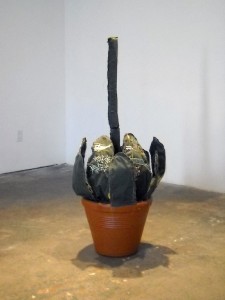
The border patrol is also a focus in Cabrera’s Space in Between series — stuffed, sewn and embroidered replicas of life-size cactus plants, displayed in traditional Mexican terra-cotta pots. Appropriately, and with considerable irony, the green material is taken from border patrol guard uniforms. The embroideries illustrate the often tragic border-crossing stories of the immigrants in Houston, who helped make them. For example, Agave depicts part of the story of its collaborator, Miguel de Luna: a figure by a river with a fence beyond, while a helicopter hovers ominously overhead.
 The swarm of 500 copper butterflies across the gallery walls showcases the now all-but-lost coppersmithing traditions of the people of Santa Clara del Cobre, Michoacan, Mexico. To produce this work, Cabrera set up a mock factory in San Antonio, where volunteers worked in assembly-line fashion to manufacture images of monarch butterflies, which migrate from the northern United States to mountain sanctuaries in Michoacan. The butterfly forms are stamped with impressions of the monarch on one side and the U.S. penny on the other.
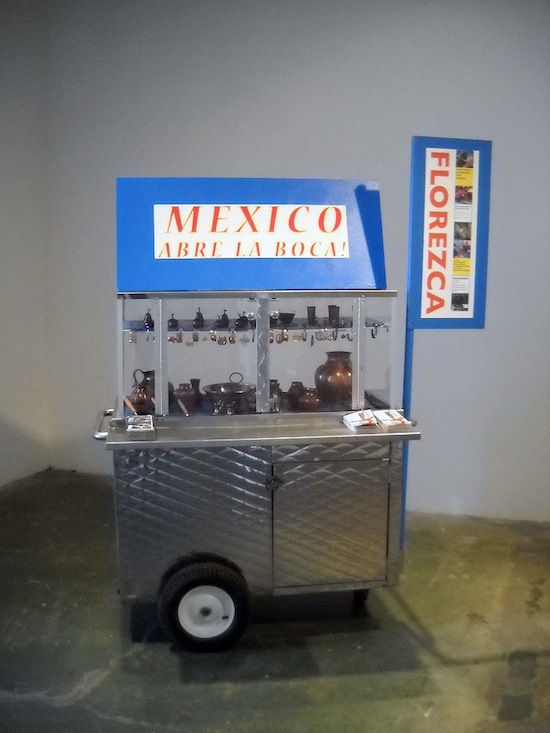
Sharing the exhibit space is a freestanding taco stand, Mexico Abre la Boca!, an installation piece and marketing site for Cabrera’s corporation, Florezca, which promotes her various projects, as well as endangered Mexican crafts, some of which are for sale on the street cart. While this corporation is of limited means, its aim of providing a humanitarian model for corporate conduct is very real. Cabrera’s workshops give workers fair wages, shared commissions, shareholder options, legal counsel, visas and help with immigrant issues.
Finally, the exhibit includes a large, round, wooden boardroom table used for a performance piece in Riverside earlier this year. It enacted a meeting of Florezca’s board of directors, with immigrant students and other supporters of California’s AB 540 and the federal government’s DREAM Act (which support pathways to citizenship through education) debating immigration issues in a mix of scripted and improvised statements. The table’s presence invites viewers to take up the debate and honor the unrepresented among us.