
Published January 15, 2004 in The Wall Street Journal
Hans Hofmann was one of the great 20th-century artists: a lyrical abstract painter; a crucial link between the European modernism of Picasso, Matisse, Mondrian and Kandinsky and the emergent New York School; inspiration to those who studied with him, like Helen Frankenthaler, Larry Rivers and Red Grooms, as well as to scores of other artists. Yet he does not enjoy the wide renown long accorded some of his contemporaries.
There are several reasons for this. For the better part of his extended artistic career (he died in 1966, one month short of his 86th birthday), Hofmann was celebrated more as a teacher than as an artist. When he exhibited his work in New York, which he did annually from 1944 to his death, it was greeted by ambivalence — viewers found it too various, inconsistent in quality and impossible to classify. Finally, Hofmann was something of a late bloomer. The critical consensus holds that his art finally “came together” during the last eight years of his life when he gave up teaching and arrived at a signature style consisting of arrangements of high-keyed color rectangles. These paintings stand as late, great manifestations of Abstract Expressionism.
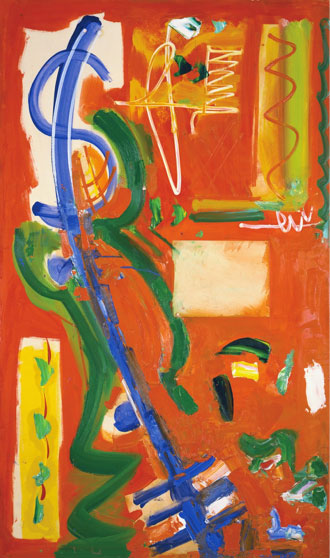 There is no question that the work he made in his late 70s and 80s includes some of the most accomplished and gorgeous paintings, not just of his career but of all late-20th-century art. But as “Hans Hofmann: A Retrospective” — currently on view at the Naples Museum of Art — ably demonstrates, he remained, to the very end, as gloriously inconsistent and restlessly inventive as he had been in the earlier part of his career. The first Hofmann retrospective in nearly 15 years, it has a well-selected sampling of just over 60 paintings drawn from the artist’s estate as well as from museum and private collections by guest curator and Wall Street Journal contributor Karen Wilkin. The exhibition provides us with the opportunity to revisit the marvelously eccentric development and wide-spanning interests of a highly influential master painter and teacher who aimed at eliciting what he called “the life-grabbing zeal in a work of art.”
Born in 1880 and raised in Munich, Hofmann lived in Paris from 1904 to 1914, where he witnessed firsthand the birth of Fauvism and Cubism, and other avant-garde movements. Back in Munich at the outbreak of World War I, he opened an art school in 1915 that achieved such fame that it attracted a number of Americans, among them Louise Nevelson. Responding to the deteriorating political situation in Germany, Hofmann moved to the U.S. in 1931, leaving behind almost all of his earlier works so that few today survive. He taught briefly at New York’s Art Students League, and then opened his own school in Manhattan in 1933, adding a summer program in Provincetown, Mass., by 1935.
The difference between Hofmann the teacher and Hofmann the artist is that while he was adept at codifying modernist ideas as theories and principles of artmaking that could be imparted to others, he struggled to assimilate those ideas into his own work.
The exhibition begins with a gallery devoted to work of about 1935-42 that captures the heady eclecticism of the artist’s early and middle years. There are still-lifes and interiors in the manner of Matisse as well as Cubist-inspired landscapes. There is even a small abstract painting, “Spring” (1944-45), executed in a drip technique reminiscent of Jackson Pollock. In the next room are works that fuse elements of Matisse and Picasso in a single painting (“Wicker Chair,” 1942) and others that incorporate birds, fish and totem-like forms in Surrealist-inspired compositions (“Ascop,” 1949).
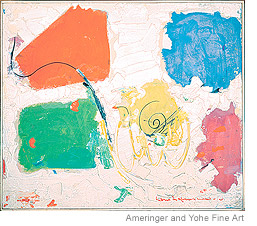 Just when it would hardly seem possible for an artist to move in still other directions, one enters the next set of galleries to encounter paintings from the 1950s variously indebted to Calder, Kandinsky, Miro, Mondrian, Picasso again and other artists. “Sketch for Mural 711,” 1957, features a dynamic mix of sources while at the same time managing to be quite personal. By the middle of the decade he is moving decisively into his distinctive brand of geometric abstraction — a number of paintings consist of colored rectangular planes that appear to advance and recede. This “push and pull,” as Hofmann called it, was designed to animate each painting and impart a sense of three-dimensions by dynamically counterbalancing forms and colors. It was the foundation of his teaching.
In the eight years between closing his school in 1958 and his death, Hofmann devoted himself to pure, color-based abstractions expressing powerful emotions that seem more the products of youthful vigor and passion than the work of someone in his 80s. The paintwork is masterly and emphatic, applied with the brush, knife, rag and hand, squeezed directly from the tube, stained, splattered and dripped.
It is unfortunate that none of the great color “slab” paintings have been included in the Naples show, paintings executed in one of Hofmann’s late styles in which blocks of vivid color float against expressionistically brushed grounds of equally brilliant hues. Still, a number of the featured late works offer their own rewards, such as the beautiful “Furioso” (1963) in which bursts, splatters and ribbons of pigment in romantic jewel tones are suspended within an endlessly expanding pictorial space.
Hofmann’s career was so multidirectional, experimental and contradictory that it doesn’t lend itself to the kind of tidy package we’ve come to expect from museum surveys. But that may be the larger lesson of this show. “Hans Hofmann: A Retrospective” offers a unique experience in that it forces us to look closely at each painting and ask what works and what doesn’t. Well after he ceased teaching, Hofmann continues to make students of us all.