Published Art in America (online), February 23, 2010
 In the photograph titled Doll, a figure in old-fashioned dress appears to float gracefully in a dark, shadowy space. But as soon as the viewer becomes aware of the structure of María Martínez-Cañas’s “Lies” series (2005)—scenes of violent death distorted to near illegibility—the fanciful-seeming image is seen to depict a woman lying dead on a carpet.
“Lies” is the earliest of the four black-and-white series shown in Martínez-Cañas’s recent exhibition “Tetralogy.” Although divergent in form, content and technique, each suite explores the nature of photographic truth, particularly digital photography’s capacity to both record and alter appearances. The artist’s career has been devoted largely to exploring her Cuban heritage; her current preoccupation with fact and falsehood was motivated by a family crisis. In 2003, her father, a prominent Latin American art dealer based in Miami, was accused of falsifying an authentication document. Although the charges were dropped, the local media delved doggedly into her father’s past. “Lies” reflects Martínez-Cañas’s initial trauma; the subsequent series show her moving toward acceptance and reconciliation.
“Adaptation” (2006) and “Tracing” (2007) make use of photographs taken by lawyer-critic-curator José Gómez-Sicre, a Cuban-born advocate of Latin American modernism and a close family friend. For “Adaptation,” Martínez-Cañas altered photographs Gómez-Sicre had taken of various museum and gallery painting installations, digitally replacing the framed artworks with blank panels. The series is both an homage and an act of defiance; the cultural father figure’s images are embraced, but his points of focus eradicated.
In “Tracing,” Martínez-Cañas superimposed pieces of vellum on selected areas of photographs taken by Gómez-Sicre during his travels around the world; she then used a pencil to trace those sections of the images obscured from view. Since the line drawings flatten, simplify and seemingly transform photographic “fact” into graphic “fiction,” the hybrid works—they are printed on canvas—offer competing levels of realism and artifice.
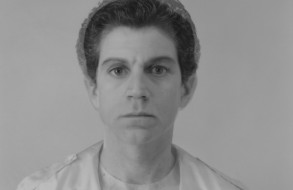
The fourth series, “Duplicity as Identity” (2008-09), superimposes a bust-length photograph of Martínez-Cañas’s father taken when he was in his 40s with an identically posed portrait of the artist at roughly the same age. The series begins with images that are 100 percent individual, then moves to incremental him-her percentage mixes: 30/70, 50/50, etc. The overlapping portraits seem at first to express a daughter’s solidarity with her father, acknowledging their similarities in appearance and their emotional connection. Yet, given the artist’s long search for an identity distinctly her own within a proud Latin American lineage, the large frontal view of a mature, confident woman staring out of the pictures also suggests a securely rooted but independent self.