Published Art in America, June/July 2008
Mark Handforth’s heterogeneous sculpture coalesced in an installation with thematic intimations of lost paradise.
Mark Handforth’s recent exhibition at Gavin Brown in New York, the artist’s first since 2005, was no less than thrilling. Proving again that he is capable of working in a variety of styles and mediums, he is presently pushing the narrative direction of his art. Unafraid of grand statements, he culls from literary and biblical references while commenting upon the state of the world.
The show consisted of seven works, two outside the gallery and five within, each in a different medium and speaking a different sculptural language. Most are large in scale, all are physically assertive, and, with the exception of two realistically rendered pieces in bronze, they take forms familiar to those who have been following the artist: a bent lamppost, a fluorescent wall piece, a traffic sign, a large star, and rusted pipes laden with burning candles. While each piece was presented discretely, the exhibition functioned as a single dynamic and cohesive whole, its units conceptually linked.
Planted upright on the sidewalk at the corner of Leroy and Greenwich streets was a rather ferocious, realistically rendered head and neck of a howling wolf cast in white bronze, with cascades of white and blue paint running from its open mouth and snout. Nearby, the base of a bent, improbably tall lamppost was embedded in the cement sidewalk. The work’s midsection, which was mostly painted orange, rose up to form an irregular star shape against the building’s outer wall, and the drooping light fixture at its end, equipped with two fluorescent violet bulbs, came to rest on the ground. The piece recalls an earlier lamppost sculpture by Handforth suggesting the form of a ruined flower with five red lights, installed in 2003 at the Doris Freedman Plaza in Midtown Manhattan, under the aegis of the Public Art Fund.
Inside the gallery to the left was a piece titled Rolling Stop, an enlarged stop sign hung upside down and somewhat tilted, made of large steel plates. Each letter of the word “STOP” is rendered differently: the “S” is in hazy black spraypaint, the “T” painted neatly in white; the “0” is a large hole and the “P” is a three-dimensional form colored with runny, blood-red paint. In the next gallery, a long rusted metal pipe ran along the floor, then twisted itself into an irregular heart shape. Burning tapers in various colors were perched at intervals along its length, the dripping wax emitting a faint sizzle as it fell to the floor, forming hardening pools. The effect was elegiac. The work might well seem sappy and sentimental if seen on its own, but Sidewalk Heart was integral to the success of the show as a whole.
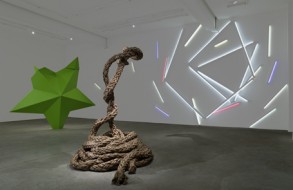
In the larger adjacent gallery were two thick ropes cast in bronze, partly coiled on the floor but with their ends rising over 8 feet into the air. The ends lift gracefully, twisting together and coming apart in a frozen balletic gesture. Nearby was the fluorescent wall piece Tumbleweed. Its many components, most white but others pale purple or hot pink, suggest some object that had once been whole but was then burst open, its parts flung to the sides and down. Implied dynamic movement, even an explosion of sorts. Finally, a large, bright green star made of steel with polyurethane seemed to have fallen from the sky to embed itself in the gallery floor. One of its two top points is bent back, while the other seems to have been broken off and then set back into position, but slightly askew. The piece, called Big Green Star, was originally titled Star (Mammon).
“Mammon” is a biblical term referring to worldly wealth and greed and often personified by a false god or demon. In lieu of an artist’s statement for his show, Handforth provided a slightly altered image of a Gustave Dore engraving for John Milton’s Paradise Lost. Dore’s print depicts the episode in which Satan’s legions, massing in the lake of fire after having been banished by God, are called upon by Satan to arise so as to retake their place in Heaven. “They heard, and were abashed, and up they sprung,” reads the caption (Book I, line 331). In the altered image, Handforth has superimposed his big, damaged star over the figure of Satan.
The clue provided by the engraving, while helpful, was hardly necessary, almost redundant, since the wolf howling outside the gallery, the “bleeding” stop sign, the exploded fluorescent form and the elegiac heart revealed much on their own. While it is true that the title of the rope piece, Hope Snakes, refers to the Fall, an allusion that slipped by this viewer until she saw the Dore” illustration, its seductive nature did not. Moreover, the two stars—the one formed by the lamppost outdoors and the fallen one within—might be understood as symbols of America, its power, leadership and stature in the world now debased. Such a reading would not be unprecedented in Handforth’s work; he himself discussed his work in the 2004 Whitney Biennial in similar terms:
“The piece Diamond Brite (2004), for example,… was a large crumpled freeway sign that I had made up, but it served as a ready-made. It looked like every other sign on Interstate 95 apart from the text. Nowhere on the 3000-mile express-way will you find such a ‘No Exit’ sign, although due to its length, the road feels like a No-Exit situation. As does much about life in America right now.”1
At the Whitney, the sign was juxtaposed with an image of the setting sun rendered in orange iluorescent lights. Seen in this context, Handforth’s exhibition at Gavin Brown seems to stand as an elegy for all that has been lost, and perhaps a plea for the restoration of order.
|
| ‘Mark Handforth” was on view at Gavin Brown’s Enterprise, New York Mar. 1-29. Handforth has upcoming exhibitions at Eva Presenhaber, Zurich [Aug. 30-Oct. 11] and Galerie Almine Rech. Paris [Oct. 23-Dec. 20]. |