Published in Art in America, June/July 2007
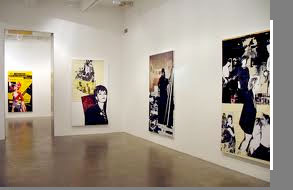
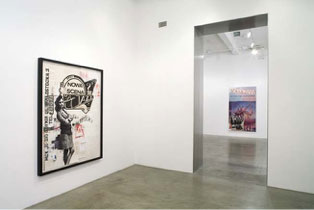
 In her first New York solo show— “Nowa Scena” (new scene)— Warsaw-based artist Paulina Olowska presented billboard-scale collages steeped in nostalgia but crackling with energy in the here and now. Photographic enlargements and texts (some neatly cut out from their sources, others raggedly torn) intermingle with drawings, abstract passages and/or painterly flourishes to resemble the pages of crude scrapbooks and fan magazines. One category of images consists of posters, record covers and photographs of boy bands associated with Poland’s 1980s punk-rock scene. Another, with bold young women of the same era wearing short skirts and gazing jauntily, rebelliously or flirtatiously out at the viewer, reinforces the sense of youthful rebellion and introduces a feminist aspect.
 Along with such counter-culture images are blow-ups of photographs and texts from Ameryka and Soviet Life, official propaganda magazines published from the ’50s to the early ’90s by the,two cold-war superpowers promoting (respectively) capitalist and communist ways of life. (In a separate, smaller-scale series of collages that were displayed on the second floor, the covers of these periodicals are adhered to loosely painted grounds.) These appropriations also tend to focus on aspects of art and culture, in this case modernist painting and dance. In Kryzys Kirchner (2006), a confident young woman in the foreground stares out at the viewer. Behind her are two fragments of paintings by Ernst Ludwig Kirchner featuring male and female figures, which bracket a group of hip young men standing before a poster advertising rock music. A dialogue is established between past and present and different modes of representation, as well as between the young people and Kirchner, who share a spirit of resistance to convention. Several works include modernist dance troupes (on the order of Oskar Schlemmer’s designs for Bauhaus ballets), while others feature Bella Akhmadulina, a Russian poet who emerged in the early ’60s and whose poems were often used as song lyrics.
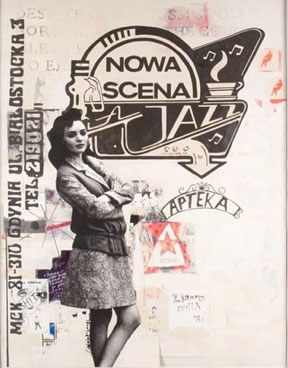 While Olowska tends to handle materials gesturally, close inspection reveals that these collages are by no means slapdash in execution; they present studied juxtapositions and repetitions of imagery and a complex layering of form. Many elements are not merely pasted on the canvas surface but are sewn on laboriously in a running stitch of black thread. A faded, grainy quality is cultivated to evoke the pre-information-age world of cheap photocopies and glossy Technicolor. Olowska chooses the tradition of collage painting—the medium of Rauschenberg and the French affichistes as well as Warhol and the British Pop artist Pauline Boty, who enunciated a proto-feminist position in her work of the early ’60s—to make a statement about Poland’s recent, pre-democratic past. Olowska’s perspective is uniquely knowing. Born in 1976, she spent her childhood in Warsaw but made frequent trips to Chicago; her degrees are from the Art Institute of Chicago and the Academy of Fine Arts, Gdansk. She has therefore experienced the cultures of East and West, capitalism and communism, from within and without. In the “Nowa Scena” collages she draws from the image bank of pre-1989, Communist Poland, the world of her childhood, to provoke a reevaluation of aspects of this overlooked society. She seems to assert that cultural endeavors of the past that today may appear dated, hokey, irrelevant or perhaps misguided have continued value, and can be inspiring in their courageous defiance of convention and Utopian ideals.
In Rock and Rolla (2006), two young women in miniskirts seen from behind lean on a counter. Their almost life-size forms, black-and-white cutouts, are superimposed on a background consisting solely of a rock poster from 1987 turned on its side; in a bold tomato red with white writing, it resembles a Coca-Cola sign. One can read some of the names of what are presumably the concert’s sponsors: “Call System” and the endearing “Kosmetyki Mrs. Pinki.” Unknowingly, the girls perch at the edge of a world that was about to disappear.