
Published as “Artschwager Pinxit”, Art in America, October 2004
Though inspired by photographs and rendered on commercial construction board, Richard Artschwager’s paintings reflect an acute awareness of art history. A survey honoring the artist’s 80th birthday sampled the conceptual and technical variety of four decades’ work.
For over 40 years, Richard Artschwager has been executing paintings on Celotex, a rigid compound board formed from pressed fibers and generally used in construction. Although it has a smooth side, Artschwager has consistently chosen the textured reverse, exploiting the rough surface as an active participant that is essential to the work’s imagery, expression and meaning. While a thin coat of black acrylic paint is used to articulate the support’s bumps and crags, the paintings convey some of the graphic presence of large-scale black-and-white drawings. Most are based on photographs, generally newspaper images enlarged to the size of easel paintings. The magnification of (he photographs, combined with the highly textured surfaces, cause the images to appeal-grainy and blurred, a hallmark of his style.
A retrospective devoted to Artschwager’s painting, which commemorated the artist’s 80th birthday, was recently organized by Bonnie Clearwater for the Museum of Contemporary Art in North Miami. Titled “Richard Artschwager: ‘Painting’ Then and Now,” it was a small, highly selective exhibition of 29 works on Celotex produced between 1962 and 2003. Among them were still lifes, portraits, figural groups, landscapes, interiors and architectural views, as well as a few allegorical paintings inspired by the events of 9/11. The technical variations found in the works on Celotex were also ably represented: for example, the artist’s incorporation of Formica panels and inserts beginning in the 1960s; his selective use of painted color and move to pattern-embossed Celotex in the 70s; and his turn to handcrafted textured materials adhered to Celotex after the board ceased being manufactured with textures in the mid-’90s.
The range of subjects and techniques seen in the show, together with the freshness and sense of immediacy embedded in the works themselves—owing to the artist’s formal manipulations and mode of address—caused each painting to stand as a kind of revelation, a world unto itself with its own ideas, challenges and concerns. As a whole, the retrospective demonstrated that for Artschwager, painting on Celotex has proved a medium rich with possibilities, sufficient to nourish and sustain him over the course of four decades, as well as one ideally suited to his sensibility and intentions.
One of Artschwager’s intentions has been to pose open-ended questions about the nature of perception and representation. All of the technical and formal means at his disposal—among them repetitions and reversals of form, spatial illusion and perspective (often deliberately askew) and specially conceived reflective or hand-painted frames—are employed to provoke the viewer not only to look, but to become self-conscious and aware in the process of looking. To this end, Artschwager mounts a direct form of address, offering close-ups and other points of view that put the spectator in the very center of the picture. The primary device in this regard, however, is grain and blur, which strain the eyes with the effort to focus the image and determine what is being seen.
Artschwager once defined art as “thought experiencing itself,”1and it seems no accident that through the years, his paintings have remained predominantly gray, the color of brain matter and cerebration. The indistinct nature of his tonal renderings also operates on a cognitive level. It is used by the artist as a metaphor for loss, inaccessibility and, ultimately and somewhat ironically (given the emphasis on thought), the limited nature of human understanding, the impossibility of gaining a full grasp on reality. In the exhibition catalogue, Clearwater maintains that Artschwager, who is generally considered the epitome of the cool, dispassionate artist (a long-standing evaluation based largely on his Formica, furniture-based sculptures), empathizes with the subjects of his paintings, which often contain personal narratives. While feelings for the subjects may be in evidence, the haziness of the images tends to function as a mask, a means by which to maintain distance and infuse the grisaille paintings with ambiguity.
 Woman with a Ball (1962), the artist’s earliest existing photo-based painting and the opening image of the show, presents a young woman in a bathing suit and cap, lying on her back, with her arms and shapely legs in the air, playfully and suggestively grasping a beach ball. While it might at first appear to be a quintessentially Pop image, recalling, among other things, Lichtenstein’s famous painting of the same title based on an advertisement and Wesselmann’s similarly open-mouthed, manicured nudes, Artschwager’s painting is intimate and nostalgia-laden, having the look and feel of an old hand-colored family photograph. The sense of intimacy is enhanced by the close-up view and the manner in which the image is cropped tightly around the rectangle formed by the girl’s back and upraised limbs, a shape reasserted by the stepped metal frame. In a perfect marriage of subject and technique, the textured Celotex evokes the graininess and faded quality of the snapshot as well as effects of light, sand and water, the dissolution of the woman’s body near the bottom edge of the picture presumably being the result of glare. The artist said of a previous painting based on a found snapshot of anonymous bathers that the figures were “not very glamorous looking. They would live their lives and they would be dead someday. I thought it would be good to paint them as they were, without satire.”2
A sense of melancholy and loss is also found in Sailors (1966), which is based on a photograph of perhaps 2,000World War II-era seamen found in a junk shop. Artschwager chose to reproduce and enlarge only a tiny portion of the panoramic image, providing close-ups that individuate (quasi-caricaturally) the uniformed figures. The effect is enhanced by the division of the image into four equal quadrants framed by shiny, grooved metal molding. A shifting and overlapping of forms occurs from one panel to the next, animating the image and activating the spectator’s eye. The reflective frames seem to belong to the viewer’s immediate physical environment, while the textured Celotex suggests an antique mosaic effect, locating the image in the past. The windowlike frame thus provides a view of a quirky, random fragment of humanity that came together, but which, in all likelihood, did not survive the war intact, some of the sailors moving into the “great beyond” signified by the open sky above.
The triptych Garden II (1974), which takes as its subject a tree-filled park, addresses a different set of concerns. Divided into three individually framed panels (and measuring more than 13 feet in length overall), the image features not a continuous panorama, but slightly overlapping views. Painstaking observation reveals a picnic table in the left-hand panel, perhaps a gazebo or structure of some kind in the central panel and a tall telegraph pole to the right, the clearly legible triangle formed by its wires seeming to mock the lack of clarity and consistent perspective that characterizes the work as a whole. A still closer view of the triptych reveals that Artschwager’s supports are Celotex boards embossed with a surface pattern of concentric circles, which he exploits to connote roses and other flower-like forms, perhaps explaining why this multipanel treescape is called a “garden.” (In Bowl of Peaches on a Glass Table, 1973, the same embossed pattern is used to evoke the roundness of the fruit.) While the warm tones and soft-edge forms of Garden II may recall Dutch 17th-century landscape drawing, and the heavily textured, atomized surface may momentarily bring to mind the haze of an Impressionist landscape, the painting’s illegibility and withholding of information ultimately frustrate the viewer in a way its precursors did not. This “garden” is at once inviting and inaccessible, the latter effect reinforced by the shiny metal frames, which counteract the work’s quasi-romantic imagery and call us back to the here and now.
A grisaille, wood-grain-painted windowlike frame is likewise used to assert the existence of another world beyond our grasp in The Cave (If you lived here, you ‘d be home now), 1992. The painting offers a view into a posh interior, similar to those seen in the artist’s “Polish Rider” series of the early ’70s, two examples of which were included in the show.8 Here, however, the artist makes a more obvious point: this is a world for the privileged few from which most of us are barred. Spatial recession, which is emphasized by the lines of the white (real) Formica tile floor, beckons us to enter the inviting room, but our access is blocked by the painted wood frame. The gestural crosshatch pattern embossed on the type of Celotex used for the support enhances the lushness of the interior, transforming the ceiling into a celestial realm. This same kind of Celotex is employed in Untitled (Fire), 1988, a painting of a skyscraper with a fire raging at its middle. The board’s pattern is engaged to convey smoke and the dissolution of the building’s structure in an image that eerily anticipates the stricken towers of the World Trade Center.
Glove (2002), which Clearwater describes as having been Artsehwager’s response to anthrax being found in the U.S. postal system, is among the artist’s most legible works with regard to its representational elements, although its meaning remains obscure. The painting suggests an allegorical portrait with its two contrasting striped-shirted female postal workers, one cheery and seemingly unconcerned (or so innocent as to be unconcerned), her bare hand clasped comfortably to her chin, the other world-weary and exhausted, her body awkwardly twisted forward, her gloved hand at the very center of the composition seemingly illuminated by and levitating a glowing yellow orb (the sun?) set in a fiat blue Formica sky.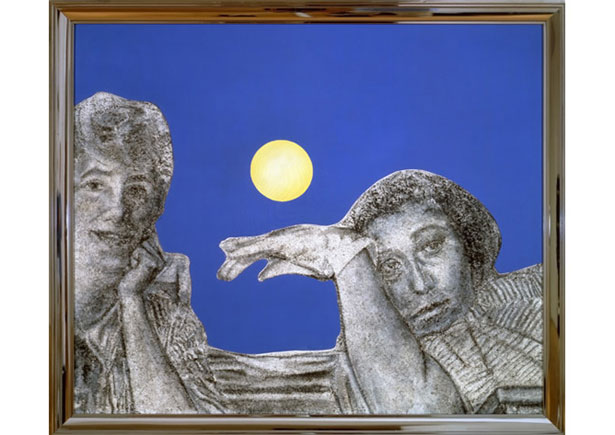
Elective Affinities III (2002) is another elusively allegorical piece in which two Western figures are set against a throng of turbaned Muslim men. The components have been assembled from a range of newspaper photos. One is a robust woman the artist has indicated is from the American Midwest and the other a diminutive man he has identified as a French legionnaire clutching a “security blanket.”4 (The work was painted after U.S. military action had begun in Afghanistan, but before public-discussions of the invasion of Iraq; thus it predates the tainting of things French and the advent of “freedom fries.”) Many of the work’s details are blurry and uncertain: Is that a sculptural bust to the left of the woman? Is there an extra hand beside her arm and is her lower half also draped in the blanket? It is clear, however, that the foreground couple and one of the Muslim men behind them look out of the picture and confront the viewer, as if to demand a reaction. The title, which Clearwater claims alludes to Goethe’s dark novel about adulterous passions, seems more likely to serve as a reference to the scientific phenomenon of the same name. Those “elective affinities” pertain to unstoppable forces of nature as regards the forming of bonds, hence the odd couple in the foreground of Artschwager’s painting and the teeming mass of male humanity behind. Again, the artist lures us in while warding us off, implying that there is only so much we can know and understand.
In Self-Portrait (2003), the most recent work in the exhibition, the details of the artist’s face are lost in a densely tangled web of lines that recalls the craquelure of old-master paintings, while at the same time veiling the image so that Artschwager does not look his 80 years. On the one hand, he appears energized by the spring-green background (a color of renewal) and the shiny metal frame that makes the image appear wholly of the moment. This is the artist confident and sure of his powers, and rightfully so, for his most recent works are as relevant and intriguing as anything he produced in the past. On the other hand, a melancholy can be seen to pervade the image, the face appearing ravaged and flayed, the eyes sad. Characteristically, Artschwager regards us from behind a mask and remains inaccessible, a seer who represents the limits and ambiguities of sight.
- Richard Armstrong, Artschwager, Richard, New York, Whitney Museum of American Art, 1988, p. 13.
- Bonnie Clearwater, Richard Artschwager, North Miami, Museum of Contemporary Art, 2003, p. 19.
- Artsehwager’s “Polish Rider” series, four principal paintings and related works, is named after Rembrandt’s painting of a man on horseback in New York’s Frick Collection and is generally said to have been so titled because, as Clearwater states, “Artschwager found Rembrandt’s manipulation of space compelling, as the vanishing point is blocked by the horseman” (p. 29).
- Information about the painting is provided in Clearwater, p. 42.