Published Art in America, March 2009
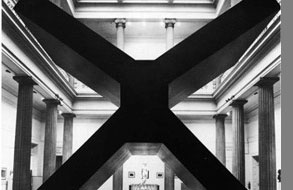
The sculptures at the core of Ronald Bladen’s career are situated between Abstract Expressionism and Minimalism. Geometric and hard-edged, but not modular or inert, the work aspires to the monumental. It is also gestural, and in some sense it functions symbolically as part of the artist’s quest for the romantic sublime. This recent show, “Ronald Bladen: Sculpture of the 1960s and 1970s,” was the first exhibition in the U.S. since a 1999 survey at P.S.1 to focus on the central phase in the career of the artist, who died in 1988 at age 70. Highlighted here were 14 sculptures and works on paper, including several rarely exhibited models and drawings from the artist’s estate, plus three garden-scale sculptures up to 6 feet tall, all expertly installed. The larger pieces had been recently fabricated in painted metal, according to the artist’s specifications, by Peter Versteeg, who had worked closely with Bladen over the years. These major pieces, as well as the studies, provided insights into Bladen’s working methods and sensibility. For instance, among the models were two wooden studies for Coltrane (1970), a work whose dynamic shapes might be viewed as an extremely abstracted portrait bust of the jazz saxophonist. One model, an openwork structure made with narrow unpainted slats, was placed on a stand next to a black-painted version of the same composition. The “skinless” Coltrane model shows how Bladen conjoined the trapezoidal prism that serves as a base with a rectangular block to suggest a violent collision of forms. Unique in Bladen’s oeuvre, this skeletal piece reveals the infrastructure that underlies most of his early monumental wooden pieces, including the well-known giant X, built at the Corcoran Gallery in 1968 (represented here by both a spare outline drawing and mural-size documentary photo).
 In the 10-inch-high Cathedral Evening (1971), a triangular wedge is dramatically cantilevered along a slightly upward-slanting horizontal plane, supported on one end by two tilting, trapezoidal mounds. The form brings to mind Bladen’s assertion that he wanted his work to have the impact of a gigantic wave, or a bridge suspended between two distant points. In V, a painted aluminum, garden-scale work originally conceived in 1975, a wedge stands on its point within a supporting structure. Set at a 90-degree angle, the “arms” of the “V” open “heavenward,” suggesting a kind of humanistic geometry, an attribute that also characterizes work by his like-minded colleagues and friends Tony Smith and Robert Grosvenor. Ultimately, the strength of Bladen’s art stems from these references to body gestures and to the upward-thrusting forms that convey spiritual aspirations.