
Published Art in America, June/July 2007
Rosalyn Drexler has had a varied career as a playwright, novelist and artist. Her paintings from the ’60s, the focus of a recent exhibition, reveal an issue-oriented Pop artist who made prescient use of images appropriated from the mass media.
For many, the exhibition “Rosalyn Drexler: I am the Beautiful Stranger—Paintings of the ’60s,” recently presented at PaceWildenstein in Chelsea, was a revelation. Drexler was a Pop artist with a difference. She shared with her better-known contemporaries—Warhol, Lichtenstein, Wesselmann and the like, with whom she often exhibited in the ’60s—the use of mass media and pop-cultural sources as well as non-illusionistic, flatly painted surfaces and clear, bright colors. She departed from their focus on consumer goods and superficial appearances, however, to tell (or evoke) stories about love, violence, race, man’s (not woman’s) relation to machines and other issues, often exploring psychologically loaded human dramas from what might today be understood as a proto-feminist point of view. Her paintings almost uncannily anticipate the media-saturated art of the 1980s—by Robert Longo, Jack Goldstein, Laurie Simmons and many others—in their technique of appropriation and critique of societal norms. Drexler’s men in black suits and women in tight skirts and heels are parents to the figures in Longo’s “Men in the Cities” series.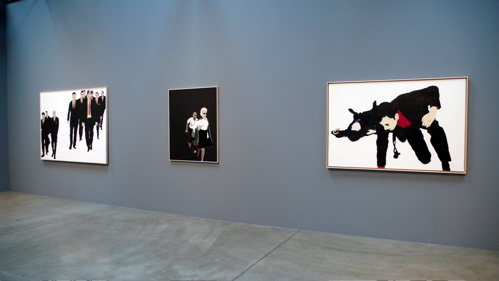
Drexler’s approach was to find compelling photographic images in newspapers, which she cut out and collaged onto the painting surface; for bigger works, she crudely enlarged the scale of the images. She then painted over the collaged images, generally allowing the halftone dots of the reproductions to peek through. Drexler tended to isolate figures against featureless, single-color grounds or to subdivide the surfaces of her pictures into blocks of color that frame individual figures or scenes, her placement of the protagonists in each case serving both the implied narrative and its expressive potential. In Lovers (1963), a kissing couple appears at the lower left corner. Behind them is an assemblage of painted and printed papers, upon which are perched a man and a woman sitting apart, their postures conveying anguished states. Are we looking at two different couples and perhaps a sequential narrative? The seated woman is at the center of the painting, the remaining three quarters of which is a flat, bright red that seems at once to echo her pain and signal the danger of her precarious position.1 Numerous smaller-scale paintings included in the exhibition likewise delve into relations between the sexes, most of them involving violence and raising issues of power and control, as revealed in such telling titles as Self-Defense, The Bite, Dangerous Liaison, Mugging Baby, It’s Alright.
The violence seen in the largest work in the exhibition, Home Movies (1963), around 4 by 12 feet, uses photographic imagery derived from both black-and-white and Technicolor gangster movies. Like Drexler’s other works with geometrically partitioned fields, its composition owes much to contemporary abstract painting. The division of the intensely red and blue surface by white bands seems to refer directly to Barnett Newman, a “zip” being used to confine to the right edge a grisaille thug who points a tommy gun directly at the viewer. Contributing to the emotional complexity of this work is its carefully studied choreography, ranging from the amusing figure on the left who peers with curiosity through a narrow rectangle-cum-door, to the rhythmic poses of the men in the top red squares at the center, to a dramatically lit, pathos-imbued pieta involving a wounded figure below. All reveal Drexler’s impressive formal intelligence and her consummate ability to tell a story.
That Drexler is not universally known has been attributed to a number of factors: the Pop movement was male-dominated; her New York galleiy, Kornblee, which also represented Dan Flavin, Howard Hodgkin, Janet Fish and Malcolm Morley, was not a major venue for Pop (in the manner of the Leo Castelli and Sidney Janis galleries); her often pointed subject matter set her apart from Pop’s mainly uncritical nature.2 In about 1967, shortly after her third solo exhibition at Kornblee (which closed in 1966, ending her affiliation with the gallery),In Chubby Checker (1964), the eponymous performer seems to have leaped out of the blue rectangle behind him to dance the Twist, which he popularized; four dancing couples appear inside green and turquoise circles beside him. The images derive from an advertisement for the 1961 movie Twist Around the Clock. Drexler has altered photo-reproductions of the original images by painting over them and setting them against brightly colored grounds. The Chubby Checker figure appears three times, this black man seen as dominating and uniting American pop culture at a time when racial tensions were tearing the country apart. More direct in this regard is Drexler’s powerful Is It True What They Say About Dixie (1966), which takes its title from a song, popularized by Dean Martin, celebrating the ease and pleasures of Southern life. In this painting, two groups of white men in black suits advance out of the picture’s uniformly white ground. In the right-hand group, the figure wearing a patterned red tie is Eugene “Bull” Connor, Birmingham’s brutally racist police chief in the early ’60s.
Drexler shifted her focus away from painting. She returned to the medium shortly before her retrospective, “Intimate Emotions,” was organized by Thomas Sokolowski for the Grey Art Gallery at New York University in 1986. (There have been three more retrospectives since 2000, the most recent at Paul Robeson Gallery at Rutgers in fall 2006.3) During her nearly two-decade hiatus from painting, however, Drexler was hardly idle. In fact, this multitalented, multidirectional artist gained considerable success in other endeavors, which might be yet another reason why the achievements of her painted work of the 1960s were not duly recognized, her “seriousness” as a painter perhaps called into doubt by her preoccupations elsewhere.
In 1964, Drexler’s first theatrical production, a musical titled Home Movies, was performed at Judson Theatre and won her the first of three Obie Awards. She went on to write over 20 additional plays, directing some of them as well. In 1965, Drexler published her first novel, I Am the Beautiful Stranger, with Grossman Publishers, Inc.,4 and proceeded over the course of the next 40 years to write some eight more, as well as, under the pseudonym Julia Sorel, five novels or novelizations. The most recent novel appearing under her own name, Vulgar Lives, was published this year by Chiasmus Press. She received an Emmy for writing excellence in connection with a 1974 Lily Tomlin television special and has published book and theater reviews in the New York Times. Among her many other endeavors, Drexler, while a young wife and mother, enjoyed a short stint in 1951 as a professional wrestler, calling herself “Rosa Carlo, the Mexican Spitfire,” an experience that was the basis for her 1972 novel To Smithereens.5 As is not surprising, given the nature of her paintings, her writing has long been acclaimed for its irreverence and innovations, its mixing of idioms drawn from high and low culture and its integration of present-day societal issues with the farcical and absurd.
Drexler is now nearly 80 years old and lives with her husband, the painter Sherman Drexler, in Newark, N.J., where she continues to write and paint. She is a national treasure and it is high time that her works of the 1960s, which have been resurrected and rediscovered any number of times, receive their due acclaim. The histories of Pop and later 20th-century art need to be rewritten with Rosalyn Drexler’s remarkably rich, prescient paintings finally playing a prominent role.
- The work operates on multiple levels, for the embracing couple is derived from an advertisement or poster for the 1962 film Jailhouse Rock, starring Elvis Presley and Judy Tyler, who died in a ear accident before the film’s release. The ethereal treatment of her figure and the collated words “co-starring” and “released” beside her no doubt serve as references to this tragic event.
- For a discussion of the neglect of Drexler’s work of the 60s, see Sid Sachs, “Two or Three Things I Know about Her (a Sketch for Rosalyn Drexler),” Rosalyn Drexler. To Smithereens: Paintings 1961-2003, Philadelphia, Rosenwald-Wolf Gallery, University of the Arts, 2004. pp. 9-13. Drexler first exhbited her work—found-object assemblages and molded plaster pieces—at New York’s short-lived Reuben Gallery (in existence from fall 1959 to spring 1961), together with Allan Kaprow, Red Grooms, Lucas Samaras, George Brecht, Claes Oldenburg and others.
- “I Won’t Hurt You: Paintings 1962-1999,” Nicholas Davies and Mitchell Algus galleries. New York, 2001); “To Smithereens: Paintings 1961-2003,” Rosenwald-Wolf Gallery, University of the Arts, Philadelphia, 2004; and “Rosalyn Drexler and the Ends of Man,” Paul Robeson Gallery. Rutgers, The State University of New Jersey, Newark, 2006.
- The PaceWildenstein catalogue for “Rosalyn Drexler: I Am the Beautiful Stranger— Paintings of the ’60s.” p. 4, stales that this book was published in 1903, by Grossman Publishers, Inc., but all previous published references date it to 1965.
- Andy Warhol paid homage to this phase in her life with his silksereen painting, Album of a Mat Queen (1902), present location unknown.