Published April 24, 2003 in The Wall Street Journal
Last year, Helen Frankenthaler painted “From the Master,” a work on paper measuring more than five-by-three feet that presents a broad area filled with billowing, cloudlike forms in red and black upon whose surface floats a single, vertical white smudge.
“The Master” in question is Rembrandt van Rijn. Ms. Frankenthaler’s painting is based on the Dutch artist’s late self-portrait in the National Gallery in Washington. The smudge in her painting was inspired by a small dab of white paint that forms a raised highlight on the tip of Rembrandt’s nose. Ms. Frankenthaler’s decision to translate Rembrandt’s unflinching confrontation with mortality through his aging self into a darkly romantic abstraction is extremely revealing of the eye and sensibility of one of the leading postwar American artists, who at 74 is also in her later years.
“From the Master” is one of 82 works included in “Frankenthaler: Paintings on Paper (1949-2002).” Organized by MoCA director Bonnie Clearwater, it is one of a series of exhibitions the museum has organized aimed at re-evaluating the careers of established American masters, and Ms. Frankenthaler’s first works-on-paper retrospective in 20 years.
 The first sections of this exhibition cover much the same ground as the previous one, certain early, formative pieces being indispensable to any survey of the artist’s work. Primary among these is the luminous watercolor “Great Meadows,” 1951, precursor to the landmark painting of a year later, “Mountains and Sea,” with which Ms. Frankenthaler initiated the transition from Abstract Expressionism to the stained Color Field painting that followed, thus taking her place in art history. (“Mountains and Sea” also hangs in the National Gallery.)
The loose drawing, spotted color and evocation of nature in “Great Meadows” shows the extent to which the artist had absorbed the work of her Abstract Expressionist elders, particularly Arshile Gorky, Jackson Pollock and Willem de Kooning. Yet its sense of boundless space and pioneering use of the staining technique — pouring the paint as had Pollock, but allowing it to soak into rather than remain on the surface — lay the groundwork for her future art.
Drawing had been instrumental in the late 1940s and early 1950s in establishing a direction for Ms. Frankenthaler’s mature painting. But it was not until 1973 that working on paper again assumed a central role in her work, this time as a surface on which to paint.
In her work on canvas, Ms. Frankenthaler seems to have felt compelled to remain true to the transparency and essential flatness of the painted picture surface. Working on paper, on the other hand, she felt liberated. She was in a world without restrictions (however self-imposed these might have been) where she felt free to indulge in tactile effects and layered surfaces and exploit metallic and other opaque paints. She began staining and even saturating paper with acrylic paint, often in a single color; occasionally, she employed a sheet of colored paper as ground.
In the works of this time and for some years after, open areas or “fields” are filled with a play of brushstrokes, textures and spots of color. Each painting is a world unto itself. Although they are abstract, most suggest the natural world. The horizontal orientation of the paper, the sense of atmosphere evoked by their handling and, sometimes, an implied division between earth and sky all suggest a vision of landscape.
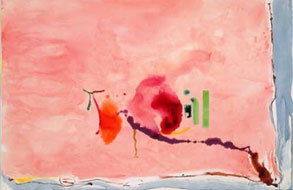
A sudden and distinctive shift occurred in the mid-1990s. Ms. Frankenthaler’s paintings on paper became as large as those on canvas, with some measuring as much as five-by-seven feet. A newly animated imagery consisting of trailing lines and color shapes dances against vast, open pastel-colored fields. The imagery recalls that found in her early stained paintings of the 1950s, but has a pronounced lyricism and even eroticism, many of the shapes suggesting bodily organs and sexual forms. It comes as no surprise to learn that these works, which bear titles such as “Flirt,” “Eve” and “Aerie,” coincided with Frankenthaler’s remarriage in 1994 at the age of 66.
In recent years, Ms. Frankenthaler has returned to dense, monochrome grounds, only this time embellished with minimal surface markings — a smudge here, a line there. For some time, she has lived and worked on a small island hard by the coast of Connecticut and the views through her windows onto Long Island Sound have made a strong impression upon her art. In the aptly named “Contentment Island,” (2002), which instills in the viewer a sensation of great calm, a vast atmospheric field is divided into areas of green and blue. Within it, a single, vertical black stroke in the “sky” is balanced by three horizontal lines (in black, white and blue), which create a “horizon.” A black smudge at the bottom of the painting is echoed by a white mark above.
It is a language of lines and smudges, colors and non-colors (blacks and whites), landscapes suggested but wholly undefined. In the hands of many of its practitioners, abstract art is an impersonal language directed at the intellect and removed from real-world appearances and experience. In Ms. Frankenthaler’s seasoned hands, carefully studied relationships between marks and forms conjure up boundless spaces of great beauty, evoking a range of human feelings in the here and now.