
Published Art in America, May 2007
 The ambience of a William Wegman exhibition is unlike any other. Adults and children of all ages gather, laughter rings out and the atmosphere is unusually animated. No artist of our time better bridges the gap between art-world audiences and the general public than Wegman, which explains the plethora of museum exhibitions that have been devoted to his art.
The most recent is the traveling retrospective “William Wegman: Funney/Strange,” organized by the Addison Gallery of American Art, Andover, Mass., where it is currently on view. It opened at the Brooklyn Museum in March 2006 and was seen by this writer at the Norton Museum of Art, West Palm Beach. Curated by Trevor Fairbrother, the show consists of about 230 photographs, drawings and paintings and 100 videos that span the artist’s career. Retrospective exhibitions of Wegman’s art were last seen in 1990, when the Kunstmuseum, Lucerne, circulated a show through Europe and major American cities, and 1996, when the Albrecht-Kemper Museum of Art, St. Joseph, Mo., sent a show to smaller cities across the U.S.
For many years, Wegman has faced a problem of sorts in presenting new work, since his early works are so revered. His technically indifferent photographs, videos and drawings of the late ’60s and early ’70s, in which his quirky mind and subversive sensibility were first revealed, have become major historical documents, emblems of performance-oriented and concept-based art. Wegman’s Polaroid photographs of his dog, Man Ray, begun in 1982, spearheaded the tidal wave of staged (or directorial-mode) photography of that decade. Alternately funny and heart-wrenching, the inventive and often gorgeous photos, and his subsequent images of Fay Ray and her offspring, are so beloved that Wegman’s audience(s) would be content to see him rest on his laurels or repeat himself. Neither option suits his nature.
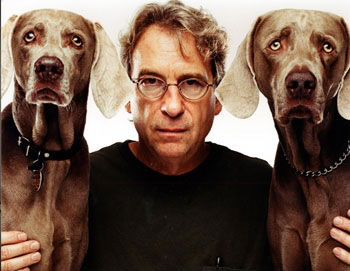 Wegman’s recent art is technically polished. Sophisticated methods of execution began with his move to Polaroids in the 1980s. He has since (selectively, as will be seen) extended this manner to his work in other mediums. After a 20-year hiatus, from 1978 to ’98, he returned to video and has released several new compilations. Since the late ’90s, his drawings have become more elaborate, ambitious and finished, many of them incorporating elements of collage. Wegman’s Polaroid portraits of his dogs have continued to appear in seemingly endless variation, and he has expanded his involvement with other photographic processes. His paintings, which he began to produce in 1985, underwent a transformation around 2002, and he has recently arrived at the most intriguing and successful such works of his career.
Yet his newer work shows that Wegman has retained both his eccentric sensibility and unassuming manner. Whereas his early work was characterized by a coolness and emotional distancing (the deadpan wit, focus on ideas, lack of “art” and use of the dog as a surrogate all serving as barriers to the expression of personal feeling), his more recent work, while hardly expressionist, displays a softening, a greater sense of warmth and humanity. He has continued to keenly observe the world about him in all of its triviality and absurdity, yet his work now conveys a new affection for its richness. The changes can be understood as a function of age and experience (among the latter, perhaps, fatherhood) as well as a response to recent art-world trends. Over the past decade (and longer), however, Wegman has operated independently, steering his own course.
A quartet of works dating from the last decade-one each in video, drawing, photography and painting-can represent the mediums and approaches of Wegman’s production, reveal the trajectory of his career and epitomize his achievements. They display some of the most recent tendencies in his art and can be profitably compared with previous works in the same mediums.
Video and Drawing
In his color video “Lecture” (1999), Wegman poses as an artist delivering a talk to a university audience. The “artist,” who speaks in non sequiturs about his work and technical processes, illustrates his lecture by having Kodachrome slides held up to the camera/audience and illuminated from behind with a flashlight. After stepping briefly away from the microphone, Wegman returns as art expert “Sidney Bernstein,” who supposedly displays an object on an opaque projector while blocking the view of the camera/audience. In his closing remarks, Wegman, once again in the guise of “artist,” thanks the school for having him and adds, “I’m going to be hanging around for a couple of weeks. If anyone wants to meet me, I’m staying at the Charles River Motel.” The piece, which is amusing and insightful in its parody of art-school practices (and pretensions), at the same time deals with failures of communication (technological and otherwise) and, as a surprising component at its end, an expression of loneliness and vulnerability. This video, which at almost four minutes is among Wegman’s longer pieces, is also uncharacteristically multipart; most of his videos, whether produced in the 1970s or created recently, revolve around a single idea.
“Microphone” (1970) can serve as a comparison, particularly as its subject slightly overlaps that of “Lecture”. In this video, Man Ray licks, chomps on and drags a live mike around on the floor for 47 seconds. The black-and-white picture is grainy and the sound understandably muffled and inconsistent, the deliberate lack of technical mastery being appropriate to its ironic, anti-technology, anti-officialdom content. “Spelling Lesson” (1973; 49 seconds), a comparable work, is a narrative piece that takes education as its theme. In this work, whose technical deficiencies echo those of “Microphone”, Wegman and Man Ray sit on chairs at a table. The artist patiently explains to the attentive canine that a word has been misspelled; the dog whines in response, simulating human sentiment.
Second in the quartet of recent examples is Wegman’s collage drawing “2 Dogs Dressed Up to Look Like Children” (1997), which literalizes anthropomorphism. It is a self-referential work in which the artist exploits the fact that he is best known for costumed portraits of dogs (these became increasingly elaborate in the 1990s, often involving the creation of canine-human hybrids with dog heads on human bodies). The piece consists of an old photograph, mounted on brown paper, of two little girls identically dressed in elaborate and quite horrid winter gear, broadly smiling as they pose for the camera. Below the image, which is collaged onto a sheet of white paper, Wegman has written the work’s title and the explanation, “They [the two dogs] were given identical sets of clothing and were instructed to dress any way they wanted to. The two dogs were unrelated in any way shape or form to the children they were asked to portray.” The piece violates all expectation, is wholly absurd and brilliantly funny. It also engenders nostalgia and a sense of identification with the children (we were all once those children). When compared with his early work, this piece has a heightened esthetic component in that the hand-printed title and text appear in colors of ink that harmonize with the sepia tones of the original brown-paper mounting of the photograph.
This work may be seen in the context of the artist’s longstanding interest in uncovering look-alikes in his drawings. Wegman first began to pursue drawing as an independent medium in 1972. Like his early photographs and videos, these were technically casual works focused on minor objects and events. A number of the graphite-on-paper drawings were devoted to calling attention to the visual similarities between different things, as in such 1973 works as “16 E’s” and “16 Ls” (the letters all written in lower-case script), “Gulls/Waves” and “4 Hairpins/4 Paperclips” (the objects shown unbent, as a series of angular lines), as well as “6 Ants”, “6 Dark Glasses”, “1 Note” (1975) and others. In the slightly later, more formally ordered ink drawing “Funney/Strange” (1982), which gives the exhibition its name, two ovals are juxtaposed. A ladder protrudes from the one on the left, suggesting a manhole, while a straw extends from the one on the right, causing the image to be read as a glass, implying a cylindrical volume. It is a magic trick, one that is indeed both funny and strange.
Photography
Conjuring a sense of magic from the everyday has long been a hallmark of Wegman’s work with dogs and is apparent in the third representative recent work, the simple but breathtaking “Ramp” (2000). This piece belongs to a series of chromogenic photographs taken outdoors using a handheld Hasselblad camera. These new works depart from the artist’s previous photographs in a number of ways. First, they are considerably smaller than his familiar 24-by-20-inch Polaroid format, and it is telling of the artist and his intentions that he moved to a modest scale at a time when wall-size prints have become ubiquitous. Second, although the new prints are precisely composed, they are shot in nature using available light and do not employ the special lighting, costumes, assistants or constructed sets involved in the Polaroids. Third, the handheld camera opened up a new kind of space for Wegman -an expansive, receding space- and he actively exploited the camera’s variable depth of field as opposed to the fixed focal length of the Polaroids.
In “Ramp”, a simple prop consisting of a wooden beam rests on the head of a dog that lies on a wooden dock. The photograph was taken up close from a low vantage point, the artist obviously being interested in the perspective offered by the converging lines of the dock’s boards and by the foreshortening of the beam; these effects combine to produce a sense of both vastness and monumentality in the intimate-scale work. The photograph features an appealing combination of warm and cool tones, but the most significant union is the life-presence of the dog (with her prone body and endearingly floppy ear) and the literal deadwood of the angled beam that conveys the idea of “ramp”. In this work, a basic concept fuses with formal intention and empathy to produce a poetic and highly esthetic object.
In Wegman’s diptych “Milk/Floor” (1970), of 30 years earlier, some of the same variables were in play. The piece consists of two silver gelatin prints taken from high vantage points that record Man Ray licking a puddle of milk off the floor. In one print the floorboards extend from left to right, and in the other they run from front to back, emphasizing directional space. Although based on a formal idea, this work was not artful. While such works as “Man Ray Contemplating the Bust of Man Ray” (1978) mark Wegman’s transition into working with more elaborately and elegantly staged scenes, an invitation from the Polaroid Corporation to work with a new roomscale camera gave his work a new visual impact. Since he began to use this camera in 1982, Wegman has produced close-up, highly focused and detailed, expertly lit and composed portraits of the dogs in saturated, enamel-dense colors. The images are reductive and often quite formal in nature, employing blank, single-color backgrounds that constitute an abstract space; the canine presence, however, ultimately defies (and renders quite absurd) any purely formal readings. As recently as 2005, Wegman began to investigate the use of double exposures in the Polaroids, opening the door to new imagery and visual effects. In “Dog Bowl” (2005), a dog smaller in scale than generally seen in the Polaroids stares out from inside a fishbowl, which gleams against an intensely black, shadowless space.
Painting
Through the years, Wegman has maintained a separation between his dog pictures (and other work) and cheap sentimentality and kitsch, with which he has often flirted. In his paintings, however, kitsch often holds center stage, as is literally the case with “Cat on a Rock” (2005), one of his most recent paintings, which will be considered shortly as the fourth work of the quartet. Though he was trained as a painter, he cast the medium aside in favor of avant-garde forms in the late ’60s. The art world witnessed a resurgence of painting around 1980, but Wegman did not return to it until 1985. At that point his work fit into the category of “bad painting,” which was then already on the wane.
Thus Wegman, who had been a pioneering figure, was now, particularly in his paintings, off on his own tangent. In contrast to his “arty” Polaroids of the time, his early paintings were characterized by harshly contrasting colors, crude drawing and mixed painting techniques in a deliberate eschewal of mastery that recalls his early photography and video. Both the style and subjects of his paintings derive from boyhood materials-grade-school primers, Cub Scout manuals, illustrated children’s encyclopedias and the like-that are freely combined in scale and genre.
Around 2002, rather than redrawing found images, he began to affix a multiplicity of picture postcards and greeting cards to his canvas and then to imaginatively extend the ready-made motifs onto the painting’s surface. This represented an expansion of a practice he had begun a few years before in drawings, where a single found image was used, as seen in “Bob and Ray” (1996). In that delightful work, Wegman conjures up a larger domestic scene using as his pivot a Christmas card from a family featuring a photograph of the two sons; the names of family members offering holiday greetings includes those of the famous radio and television duo (on the air 1946-87) who served as an ongoing source of inspiration for the irreverent wit, absurdist view of the quotidian, and role playing of Wegman’s art. The new paintings are extremely detailed, featuring multiple points of interest and perspectives (thus often having a near-kaleidoscopic effect) and are time-consuming both to produce and experience. Much of the work focuses on architecture and city views.
“Cat on a Rock”, however, presents a vast, almost panoramic landscape with a postcard featuring an adorable kitten (read: kitsch) affixed to its very center. Other postcard images are dispersed throughout the composition by means of a kind of free association triggered by the various landscape elements. The cat in the postcard, for example, is perched on a beige ground, which Wegman extends onto the surface of his support by painting a cluster of rocks. To the left, they serve as a vantage point from which two cowboys on horseback view the landscape, while below they furnish a zoological habitat for hippos. A lake behind the cat to the left makes the perfect setting for a large red modernist sculpture, while the far bank of the lake becomes a paradisiacal setting for Leonardo da Vinci’s “Leda and the Swan”. Elsewhere in the picture, another body of water offers a recreational area for kayakers. Wegman uses various styles and techniques in rendering his landscape, taking cues from the collaged printed images. Even more than in his earlier paintings, he mixes images of different genres: Leonardo and Leda meet the marmalade kitty and the Jolly Green Giant (who appears in a billboard at the upper right). This work is therefore characterized by a leveling of the categories of printed matter, something done a half-century ago in the Combines of Robert Rauschenberg and reiterated through the appropriation filled, postmodernist days of the 1980s. Here the strategy looks wholly invigorated, even with its nostalgia-laden content. Perhaps Wegman’s use of found images appears fresh because of the manner in which he integrates them into a representational whole, or perhaps it’s because of the spirit of the work, which is amiable and good-humored rather than ironic or critical. Reproductions of old-master paintings, cheap sentimental postcards, advertising images and more come together to reveal a world that is at once inconsequential, bountiful and absurd.
Thus, whether working in video, drawing, photography or painting-which he seems to do concurrently-Wegman continues to reinvent himself. Over the course of the past decade, he has explored new techniques, processes and styles and extended his work in fruitful new directions. Independent of art-world trends, Wegman marches to the beat of his own drummer, with his dogs scampering happily alongside.
“William Wegman: Funney/Strange” opened at the Brooklyn Museum [Mar. 8-May 28, 2006] and traveled to the Smithsonian American Art Museum, Washington, D.C. [July 4-Sept. 24, 2006], and the Norton Museum of Art, West Palm Beach [Nov. 4, 2006-Jan. 28, 2007]. It is currently on view at the Addison Gallery of American Art, Phillips Academy, Andover, Mass. [Apr. 7-July 31]. A catalogue written by Joan Simon accompanies the exhibition.